
Moving for the Schools: How to Navigate Home Buying, School Transfers, and a Stress-Free Neighborhood Transition
Moving for the Schools: How to Navigate Home Buying, School Transfers, and a Stress-Free Neighborhood Transition
Moving to a new home is one of life’s biggest milestones. When that move is driven by finding the right school district for your children, the stakes can feel even higher. Whether you are planning a back-to-school move before the autumn semester begins or navigating a mid-year school transfer, balancing home closing dates with academic calendars requires both a practical strategy and emotional support for your family.
This comprehensive guide covers everything you need to know about changing schools when moving, managing emotional stress for kids, parents, and pets, handling enrollment paperwork, and getting to know your new community before day one.
💡 Key Takeaways: Back-to-School Moving Checklist
-
Verify boundaries directly: Always confirm school zoning with the district's administration office, not just real estate listings.
-
Gather paperwork early: Have proof of residency (closing disclosure or purchase agreement), immunization records, transcripts, and IEP/504 plans ready in advance.
-
Support the whole family: Acknowledge the emotional impact on children, parents, pets, and friends left behind.
-
Connect with neighbors early: Knocking on doors and meeting neighborhood families before school starts gives your child built-in classmates on their first day.
1. Acknowledging the Stress: How Moving Affects the Whole Family
Before diving into real estate paperwork and registration forms, it’s essential to acknowledge the emotional weight of relocating. A school district transfer isn't just a change of address; it’s a complete shift in daily routine.
For Kids and Teenagers
Leaving behind best friends, familiar teachers, favorite sports teams, and comfortable spaces can feel like losing their whole world. Even if they are excited about a bigger bedroom or a backyard pool, grief over what they are leaving behind is completely valid.
For Parents and Caregivers
Juggling real estate deadlines, packing logistics, mortgage underwriting, job responsibilities, and school enrollment deadlines while trying to keep the household calm is exhausting. Give yourself grace during this transition.
For Family Pets
Dogs and cats are extremely sensitive to human stress and changing physical environments. Packed boxes, missing furniture, unfamiliar sounds, and disrupted feeding routines can cause anxiety and behavioral changes.
-
Pro-Tip for Pets: Keep pet beds, familiar blankets, favorite toys, and feeding bowls unpacked until the final hours. Set up a quiet, familiar room for them in the new house immediately upon arrival.
For Friends and Loved Ones Left Behind
Moving away from trusted neighbors, extended family, or long-time friends creates a void for everyone involved. Reassure children and yourselves that physical distance doesn't mean ending relationships—schedule structured video calls or plan a return visit before you even pack the moving truck.
2. The Practical Playbook: How School District Transfers Work
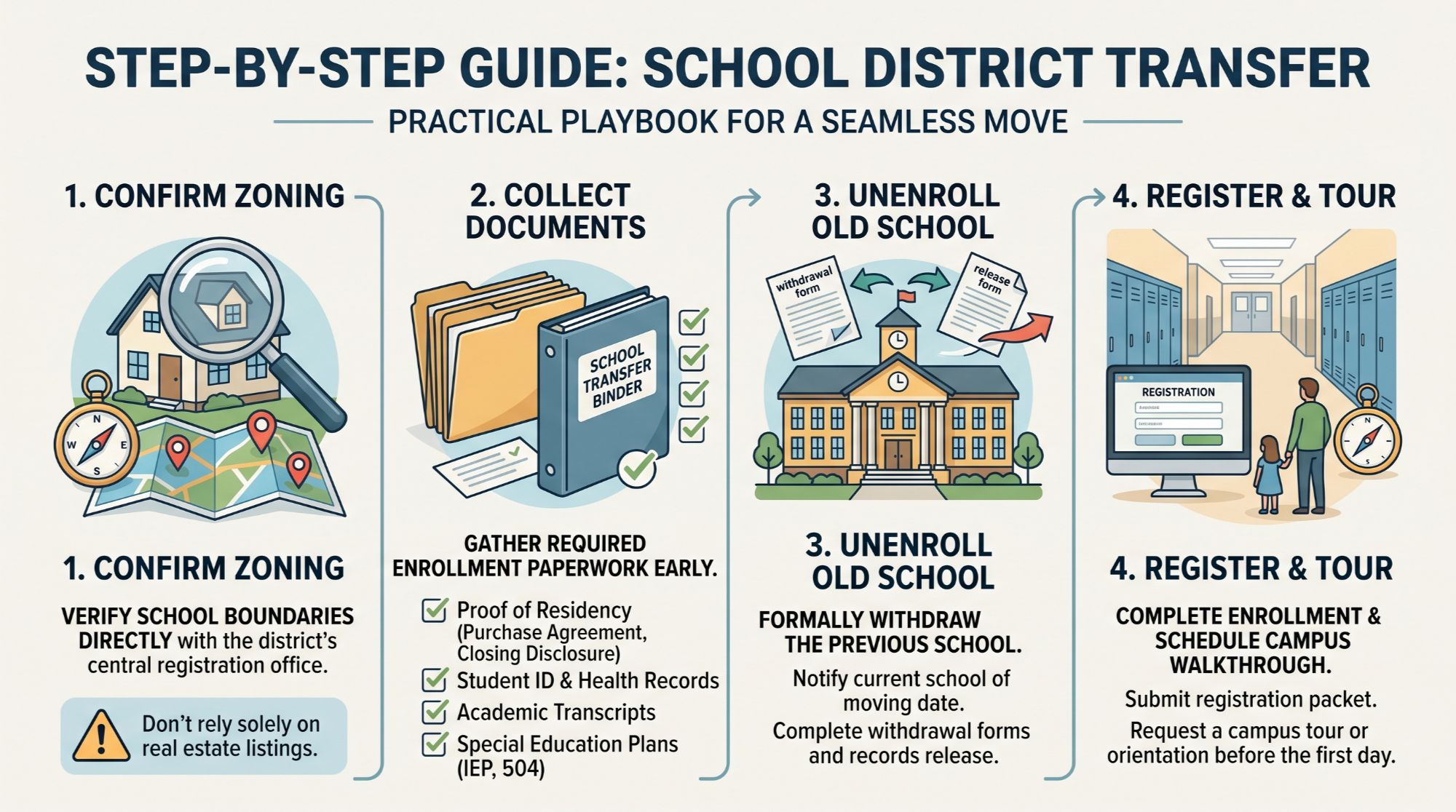
When buying a home with a specific school district in mind, timing and accuracy are critical. Follow this step-by-step roadmap for a seamless educational transfer.
➡️  Step 1: Confirm Zoning
➡️  Step 2: Collect Documents
➡️  Step 3: Unenroll Old School
➡️  Step 4: Register & Tour
Step 1: Verify School District Boundaries Directly
Never rely solely on real estate listing descriptions or automated map tools. School district boundaries can split single streets, cut across neighborhoods, or change due to local redistricting. Call the target school district’s central registration office or use their official address-lookup portal to verify that your prospective address is zoned for your intended school.
Step 2: Gather Required Enrollment Documentation Early
School districts enforce strict proof-of-residency rules to manage capacity. Compile these items into a dedicated "School Transfer" binder:
-
Proof of Residency: Signed purchase agreement, closing disclosure statement, lease contract, or recent utility bills (electric, water, gas) under your name at the new address.
-
Student Identification & Health Records: Certified birth certificate, government-issued photo ID for parents, state-compliant immunization records, and recent physical examination forms.
-
Academic & Administrative Records: Current report cards, official academic transcripts, standardized test results, and withdrawal clearance forms.
-
Specialized Education Plans: Updated Individualized Education Plans (IEP), Section 504 accommodation plans, or Gifted and Talented program documentation.
Step 3: Formally Unenroll from the Previous School
Notify your child's current school of your moving date as early as possible. Complete an official withdrawal form and sign a records release authorization so cumulative academic, health, and disciplinary files can be securely transferred directly to the new district.
Step 4: Complete Enrollment & Schedule a Campus Walkthrough
Submit your completed registration packet to the new school. Once accepted, request an in-person orientation or campus tour before your child’s first official day. Walking the hallways, locating their desk or locker, visiting the cafeteria, and finding the bus drop-off zone turns fear of the unknown into manageable familiarity.
3. The Secret Weapon: Getting to Know the Neighbors Early
One of the most effective strategies for a smooth school transition happens right on your new front porch. Connecting with your new community before the school year starts transforms an intimidating move into a warm welcome.
Most Neighbors Are Excited to Meet You
It is common to feel hesitant about knocking on doors in a new neighborhood, but the overwhelming majority of neighbors are genuinely excited to welcome newcomers. A vibrant neighborhood relies on open community, and people love knowing who lives next door.
Finding Built-In Support Networks
In family-friendly neighborhoods, parents frequently form tight-knit support systems. You will often find neighbors who trade carpooling responsibilities, organize walking school buses, share advice on local youth sports leagues, and look out for kids playing outdoors.
Jump-Starting Your Child’s Social Life
If you move during the summer or a school break, introduce yourself to neighboring families and ask if there are children attending the same school. Meeting even one future classmate on your street before school begins means your child won't have to face the cafeteria or school bus alone on day one.
4. Practical Tips for a Smooth Back-to-School Transition
For Children
-
Involve Them in the Move: Let children help pack their bedrooms, pick out paint colors, or design their new homework setup.
-
Maintain Core Routines: Keep bedtime hours, meal schedules, and favorite weekend family traditions consistent throughout the moving process.
-
Validate Their Feelings: Create safe spaces for kids to express sadness or fear without immediately jumping to fix or dismiss their emotions.
For Adults
-
Build in a Move Buffer: Whenever possible, schedule your home closing 1 to 2 weeks before the school term begins. This buffer allows you to unpack essential living spaces and practice the new commute before school starts.
-
Connect with the PTA/PTO: Join the school’s Parent Teacher Association or local neighborhood social media groups to get early answers about dress codes, school supply lists, bell schedules, and upcoming events.
-
Coordinate Special Needs Early: If your child relies on an IEP, 504 plan, or medical accommodations, arrange an intake meeting with the new school's support coordinator several weeks prior to the start of classes.
❓ Frequently Asked Questions (FAQ)
What happens if our home closing is delayed until after the school year starts?
Most public school districts offer conditional enrollment if you present a signed purchase contract or closing statement with a confirmed closing date (typically within 30 to 60 days). Parents usually sign a temporary residency affidavit until permanent utility bills are available.
Can my child finish the current school year at their old school if we move mid-year?
Many school districts permit students who move mid-semester or mid-year to complete the ongoing academic year at their original school. However, parents are generally required to provide daily transportation, as district school buses will not cross district boundaries.
How do I evaluate a new school district beyond standardized test scores?
Look at student-to-teacher ratios, teacher retention rates, advanced course offerings (AP, IB, Honors), extracurricular and athletic programs, special education resources, and active parent-teacher organization (PTA) involvement. Contacting the school principal or attending a public school board meeting can also offer valuable insights into community culture.
What happens if school district boundary lines change after buying a home?
School boards periodically adjust boundary lines to accommodate regional population growth. When redistricting occurs, many districts include a grandfather clause that allows currently enrolled students—and sometimes their siblings—to remain at their current school through graduation.
Final Thoughts
Buying a home in a great school district is an investment in your family's future, but navigating the move successfully requires a plan that accounts for both paperwork and people. By managing emotional stress, preparing enrollment documents early, and reaching out to neighbors before the first bell rings, you will set your children—and your entire household—up for a confident, successful school year.
Categories
Recent Posts










Real Estate Advisor License ID: 2020002093
+1(513) 323-6822 | ahagenstein@hsrellc.com