
The "Steal of a Deal" Trap: Why the Cheapest House on the Block in Ohio Can Cost You the Most
The "Steal of a Deal" Trap: Why the Cheapest House on the Block in Ohio Can Cost You the Most
By Adam Hagen-Stein
Real Estate Advisor | HSRE LLC Real Estate Solutions & X Real Estate
💡 Quick Takeaways
-
Price vs. Value: The lowest purchase price rarely equals the lowest monthly or long-term cost.
-
Ohio-Specific Money Pits: Old clay sewer lines, foundation bowing from freeze-thaw cycles, outdated electrical panels, and inefficient 1950s heating systems can quickly erase $40,000+ in "equity."
-
The "Deferred Maintenance Tax": Cosmetic fixes are easy; structural and mechanical "debt" is where budget-friendly dreams go to die.
-
Smart Strategy: Focus on buying a home with solid structural and mechanical bones in a great neighborhood, rather than chasing the absolute lowest price tag on Zillow.
Picture this: It’s 11:30 PM on a Tuesday. You’re on Zillow or Redfin, scrolling through your favorite neighborhood in Central Ohio. Suddenly, you see it.
A house in your dream school district or walkable historic neighborhood listed for $60,000 less than every single home around it.
Your eyes light up. You instantly calculate the savings: "If we buy this for $225k while everything else is selling for $290k, we’ll walk in with $65,000 in built-in equity! We can just fix up the kitchen over time, right?"
Hold your horses, my friend. Pour a fresh cup of coffee, sit back, and let’s have an honest, real-talk conversation about real estate.
As someone who spends every day walking through Ohio homes—from historic 1920s Merion Village craftsmans to suburban ranches—I’m going to share a golden truth that every buyer needs to hear: In Ohio, the cheapest house on the block is very often the most expensive house you will ever own.
Here is why that "unbelievable deal" is usually a trap, and how you can protect your wallet while still making a savvy investment.
1. The "Ohio Weather Effect" on Older Foundations
Let's talk about something uniquely Midwestern: our soil and weather.
Ohio experiences dramatic temperature swings. We go from 95°F and humid in August to sub-zero freeze-thaw cycles in January. Combine that with heavy spring rains and dense clay soil, and you get massive hydrostatic pressure pressing against foundation walls.
When a home is the cheapest option on the block, the low price is rarely just about dated wallpaper or 1970s avocado green shag carpet. More often than not, it’s because the previous owner deferred critical maintenance for 20 years.
What that means for your bank account:
-
Bowing Basement Walls: Fixing a block foundation wall with carbon fiber straps or vertical steel I-beams can run $5,000 to $15,000+.
-
Water Intrusion: Installing an interior perimeter drain tile, sump pump, and wall vapor barrier to keep a cellar dry usually starts at $8,000 to $12,000.
If a house is priced $40,000 below market, but needs $25,000 in hidden concrete and drainage work before you can even think about painting, that "deal" has already evaporated.
2. Underground Liabilities: The Unseen Clay Sewer Line
When you walk through a house, you check out the hardwood floors, the kitchen countertops, and the natural light in the living room. But the most expensive system in an older Ohio home is one you can't even see: the lateral sewer line running beneath the yard to the street.
Homes built in Ohio prior to the late 1970s frequently utilized cast iron or clay pipe laterals. Over 50 to 80 years, tree roots penetrate the pipe joints, causing cracks, bellies (sagging), or complete structural collapse.
The Hidden Cost:
-
A routine rooter/hydro-jetting service might clear a clog for $300, but if the main clay line under your driveway or lawn has collapsed, replacing it via open-cut excavation can cost $10,000 to $20,000.
-
Even modern trenchless CIPP (Cured-In-Place Pipe) lining typically runs $4,000 to $8,000.
Pro-Tip: Whenever my clients look at a home built before 1980—no matter how cheap or pretty it looks—we always perform an independent sewer scope during our inspection period.
3. The "Mechanical Debt" Snowball
Think of a home's major systems like credit card debt: if you don't pay for routine maintenance along the way, the interest accumulates fast.
When you buy the cheapest home in the area, you are almost always inheriting a home with an stacked list of end-of-life mechanicals:
-
The Roof (15–20 year life): Replacement cost = $8,000 – $16,000
-
The HVAC System (12–15 year life): Replacement cost = $7,000 – $14,000
-
The Water Heater (8–12 year life): Replacement cost = $1,500 – $2,500
-
Electrical Service (60–100 AMP outdated panels, ungrounded wiring): Upgrade cost = $3,000 – $7,000
If all four of these major components are hitting the end of their lifespan at the exact same time, you're looking at $20,000 to $35,000 in immediate cash out-of-pocket expenses just to keep the home warm, safe, and dry.
Suddenly, paying an extra $20,000 upfront for the move-in-ready home next door—where the roof, HVAC, and electrical were updated three years ago—becomes the far cheaper option!
4. Renovation Budget Inflation (and Cash-to-Close Shock)
Here is a common scenario I see all the time:
A buyer has $30,000 in savings. They decide to buy a "bargain" fixer-upper for $200,000 instead of a renovated home for $250,000. They figure they'll use their leftover cash to fix it up.
Here is where the math catches people off-guard:
-
Closing Costs & Down Payment: Takes $18,000 of their cash.
-
Remaining Renovation Cash: $12,000.
-
The Reality: Material costs, contractor labor rates, and unexpected permit requirements mean that a $12,000 renovation budget gets consumed by just paint, flooring, and a few light fixtures.
When you finance a move-in-ready home at $250,000, that $50,000 difference is spread out over a 30-year fixed mortgage at a predictable monthly payment. But when you buy a fixer-upper, the renovation costs must come directly out of your liquid savings today.
How to Spot the Difference Between a "Bargain" and a "Trap"
Does this mean you should never buy a house that needs work? Absolutely not! Sweat equity is one of the best ways to build long-term wealth in real estate.
The key is knowing the difference between Cosmetic Debt and Structural Debt.
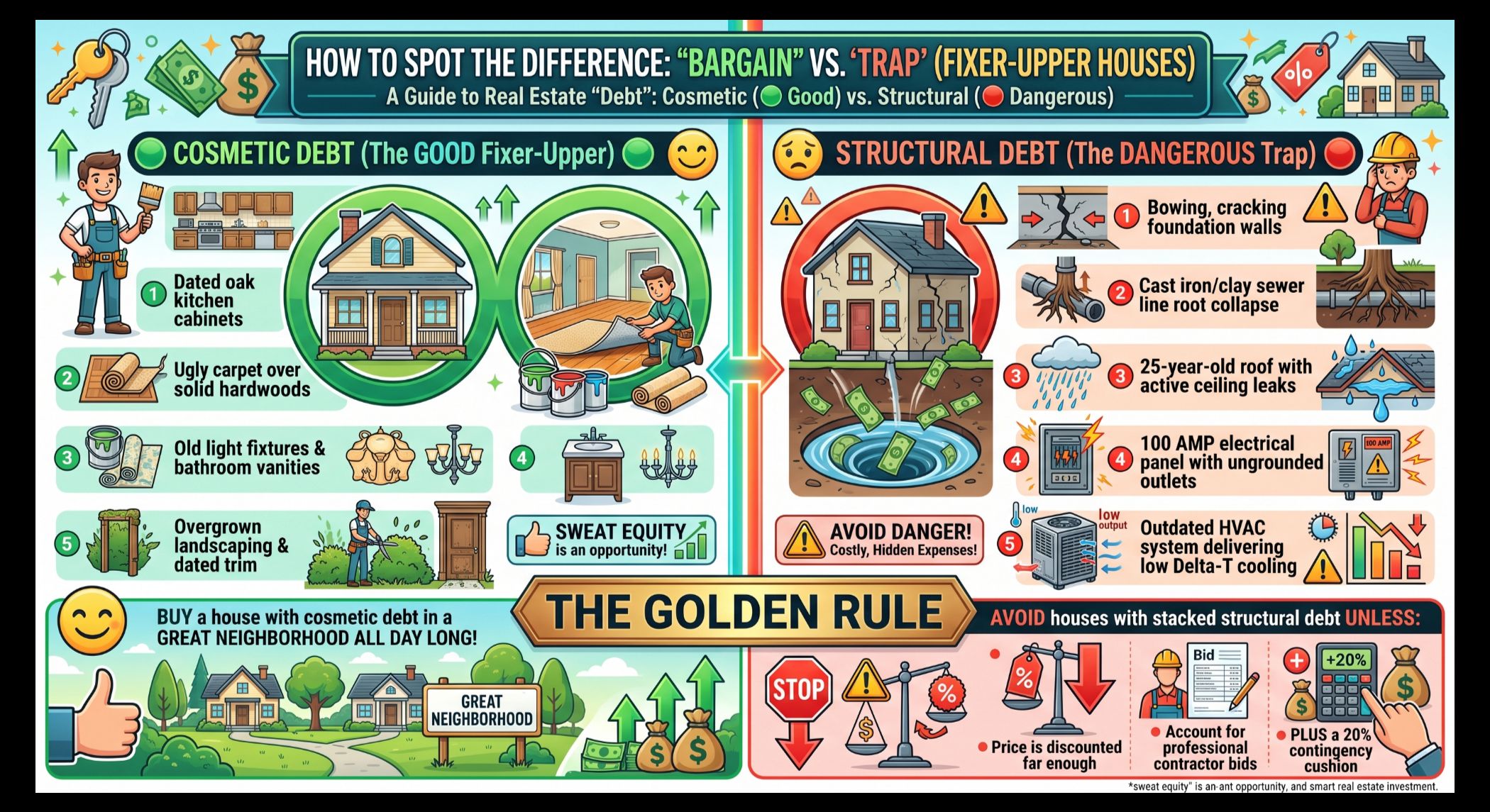
The Golden Rule: Buy a house with cosmetic debt in a great neighborhood all day long. Avoid houses with stacked structural debt unless the price is discounted far enough to account for professional contractor bids plus a 20% contingency cushion.
❓ Frequently Asked Questions (FAQ)
Q: Isn't it always best to buy the cheapest home on a great street?
A: Traditional real estate advice says "buy the worst house on the best block." That is true if the issues are primarily cosmetic (paint, flooring, landscaping) or if you are an experienced contractor with liquid capital. However, if the price is low because of severe structural, foundation, or main utility line failures, the repair costs will almost always exceed your initial price savings.
Q: How can I tell if a low-priced home is worth bidding on?
A: Before waiving contingencies or writing an aggressive offer, work with an experienced real estate advisor to pull recent neighborhood comparable sales ("comps"). During your inspection window, bring in licensed tradespeople (home inspectors, plumbers for a sewer scope, and structural engineers if needed) to get hard contractor quotes before your earnest money risk period expires.
Q: What is the most important inspection to run on an older Ohio home?
A: In addition to a comprehensive general home inspection, always run a sewer scope and check the electrical grounding. In older Central Ohio neighborhoods, sewer lateral replacements and full-house rewiring are two of the most common surprise $10,000+ expenses new homeowners face.
Ready to Find Your Next Home the Smart Way?
Real estate is one of the greatest tools for building wealth and stability for your family, but only when you have clear, honest data on your side.
Whether you're looking for a turn-key gem or a smart cosmetic project with real upside in Grove City or Central Ohio, my team and I are always here to help you navigate the numbers, uncover hidden liabilities, and find a house you'll love living in.
Got questions about a listing you're looking at right now?
Shoot me a text or reach out through our site—let's do some digging together!
Categories
Recent Posts









Real Estate Advisor License ID: 2020002093
+1(513) 323-6822 | ahagenstein@hsrellc.com